When Dollars Become Software
Stablecoins made the dollar programmable, portable and instant. None of that erased the banking, liquidity and jurisdiction problems that made cross-border money slow in the first place.

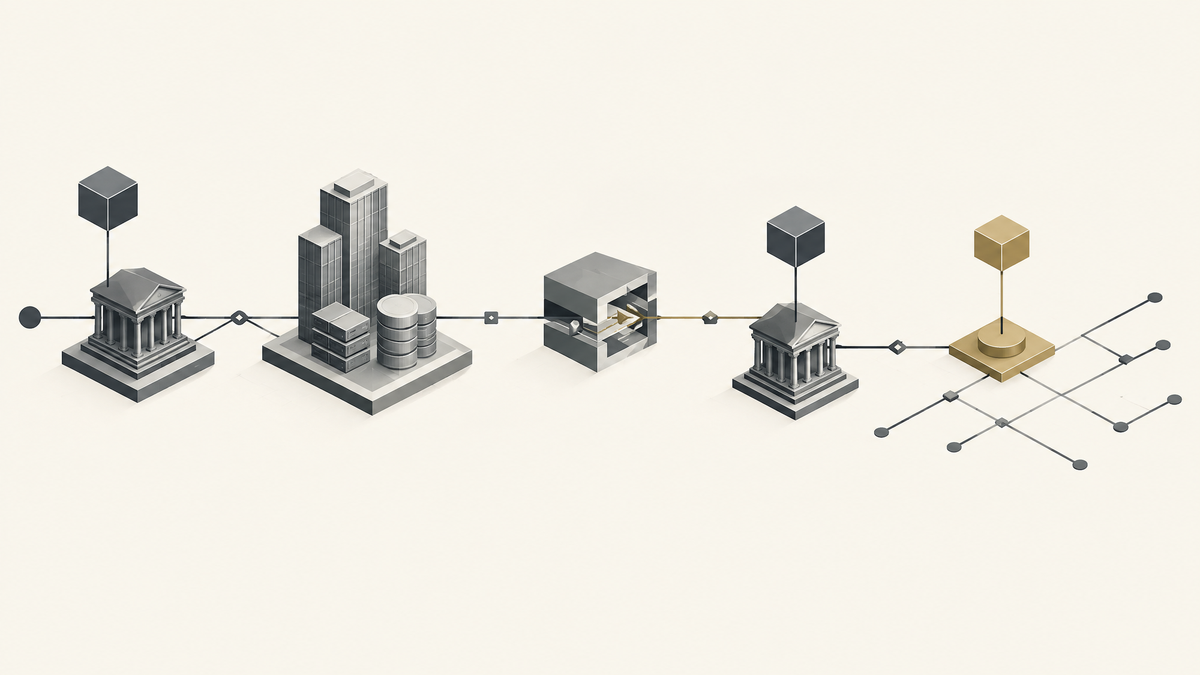
Money looks like software now. It is not software.
That gap is the whole thesis of this piece.
What stablecoins are not
A stablecoin is not a faster bank account. It is not a cheaper Western Union. It is not, on its own, evidence that banking is going away.
I have read all three of those framings in the last year, usually from people who have never had to reconcile a dollar leg against a real BRL settlement inside a real Brazilian bank. Each framing captures something true and misses the actual shift.
The actual shift is simpler, and harder to summarize in a headline: a dollar can now behave like an API call. It can move at any hour, be split, routed, held, and rerouted by a script instead of a wire desk. That is new. Banks did not build that. Card networks did not build that. A handful of dollar pegged tokens, running on public blockchains, built that, almost by accident, as a side effect of crypto trading needing a stable unit of account.
This should matter to people who have never owned a token. A treasurer deciding how to fund a subsidiary. A CFO comparing wire costs against a newer rail. A payments team choosing a settlement partner. None of them need an opinion on crypto as an asset class. They need an accurate model of how a dollar actually moves now, and that model changed under their feet whether they were watching or not.
The software layer
Here is what changed, concretely.
Money became programmable. A stablecoin balance can sit inside a smart contract with logic attached to it: release on delivery, split by percentage, expire after a window. None of that required a change to any banking law.
Money became portable. The same balance that settles a trade on one exchange can, in the same afternoon, pay a supplier on another continent, without a correspondent bank in the middle.
Money became API native. You do not call a relationship manager to move it. You call an endpoint.
Money became always on. There is no cutoff time, no batch window, no "next business day." A stablecoin transfer does not know it is a Saturday.
Money became globally routable. The same token, the same rail, works whether the counterparty sits in São Paulo, Lagos, or Manila.
Total stablecoin market capitalization sat at roughly $308 billion as of August 13, 2026, according to DefiLlama. That is not a niche instrument anymore. That is a functioning parallel settlement layer, sized like a mid tier national payments system.
What software still needs
Here is the part most crypto commentary skips, because it is less exciting than the first half.
None of that programmability changes what has to happen for a dollar to become spendable value in someone's actual life. It still has to touch banking somewhere. Somebody still has to hold the reserve, somewhere, in a real jurisdiction, subject to real audit and real seizure risk. It still has to touch liquidity: someone has to be willing to sit on the other side of the trade at a price you can actually execute at, not a screen price. It still has to touch FX, because almost nobody's rent, payroll, or tax bill is denominated in the stablecoin itself. It still has to touch capital, because moving size requires balance sheet, not just code. It still has to touch settlement, because a transfer that "confirms" on a blockchain and a transfer that is final, irrevocable, and usable in the local financial system are two different events. It still has to touch jurisdiction, because the rules for who may issue, custody, or redeem that dollar are set by governments, not by protocols. And it still has to touch compliance, because none of the previous six items exist outside a legal obligation to know who is moving the money and why.
I would put it this way. The software layer changed the interface. It did not change the plumbing underneath it. The plumbing is still banks, FX desks, licensed custodians, and regulators. Software made that plumbing faster to reach. It did not replace it.
Three pieces, one thesis
I have written around this from different angles already, and I am not going to repeat those arguments here.
I have written about how stablecoins are reshaping international FX itself, at the transaction level: what it costs, how fast it clears, who captures the spread. I have written about Brazil's own regulatory reorganization, where the digital assets market is not collapsing but consolidating, through BCB licensing tiers and a wave of mergers, into something more institutional. And I have written about Drex against private stablecoins, where the honest answer is specialization rather than a winner: a permissioned central bank rail for institutional settlement, and public stablecoin rails for cross border access, sitting next to each other rather than replacing each other.
Read together, those three pieces describe a system in motion. This piece is the thesis sitting above them: the reason any of that motion matters to someone who has never opened a crypto exchange. It matters because the underlying unit, the dollar, is quietly becoming programmable infrastructure, while every constraint that made cross border money slow and expensive in the first place is still fully in force. You do not get to skip the second half by being enthusiastic about the first.
What I see from the operator seat
At Coins.xyz, we sit exactly at that seam. A client does not experience "a stablecoin." They experience a dollar that needs to become usable reais, on a specific day, at a specific bank, without breaking a reconciliation or triggering a compliance flag. Getting that right has nothing to do with how elegant the token design is. It has to do with whether the off-ramp bank relationship holds, whether the FX price you quote survives the seconds it takes to execute, and whether the paperwork behind that transfer would survive an audit.
That is the part the "money as software" framing tends to erase. Software does not clear a Pix settlement. A licensed institution does, inside a specific regulatory framework, with real counterparty risk sitting somewhere in the chain. I have watched teams treat the stablecoin leg as the hard part of a transfer and the banking leg as an afterthought. In practice it is almost always the reverse. The token moves in seconds. The banking relationship that turns it into spendable reais took months to build and can take one bad audit to lose.
The part that does not change
None of this is an argument against stablecoins. It is an argument against a specific kind of enthusiasm: the idea that because the token layer is new and fast, the underlying economics of moving money across a border have become new and fast too.
They have not. Capital still has a cost. Liquidity still has to be sourced from someone willing to hold the risk. Jurisdictions still disagree with each other about who is allowed to touch a dollar and under what license. Compliance obligations do not shrink because the settlement rail got faster. If anything, faster settlement makes the surveillance problem harder, not easier.
Brazil is a useful test case precisely because it is not a weak state improvising rules on the fly. It has Pix, a modern payments base, and a regulator actively building a licensing regime for virtual asset service providers. Even here, with genuinely good digital infrastructure, a stablecoin transfer still ends its journey inside a licensed institution that answers to the Central Bank. The software got faster. The gatekeeping did not disappear. It moved.
The programmable dollar is real. The frictionless dollar is not, and will not be, until banking, liquidity, capital, settlement, jurisdiction, and compliance stop mattering. I do not expect that to happen in my working lifetime.
What would change my mind
I would take this thesis less seriously if a jurisdiction the size of Brazil, the US, or the EU let a stablecoin issuer redeem, custody, and move value at scale with no banking relationship, no licensed custodian, and no compliance obligation anywhere in the chain, and it worked at real volume for a real length of time. As of this writing, I am not aware of that having happened anywhere. Until it does, "money as software" describes the interface, not the system.
This piece does not claim the banking layer is going away. It claims the opposite. The banking layer is exactly what determines whether the software layer means anything at all.

Read in Portuguese: Quando o dólar vira software
Follow the money through Brazil. Subscribe to ONCHAIN FX Weekly for the next note on markets, capital and the systems behind moving serious money.