A CFO's map of Brazil: capital, FX, liquidity and settlement
Most people ask about Brazil in the wrong order.

Most people ask about Brazil in the wrong order.
They ask about the FX rate first. Then the bank. Then, much later, if something breaks, they ask about the regulation that was sitting there the whole time.
I want to lay out the order that actually works, before the rate becomes the question.
This is not the cost piece
Readers of "What does it actually cost to move $10 million through Brazil?" already know the framework: ALL-IN ROUTE COST equals execution plus capital plus time plus operations plus risk. That piece prices a route once the route is already understood.
This piece is about understanding the route in the first place.
Think of this as the map that comes before the cost piece, not after it. A CFO who has not moved capital through Brazil before should start here. One who has can still use it as a checklist of what the cost framework assumes is already known.
The five layers a CFO has to hold in their head
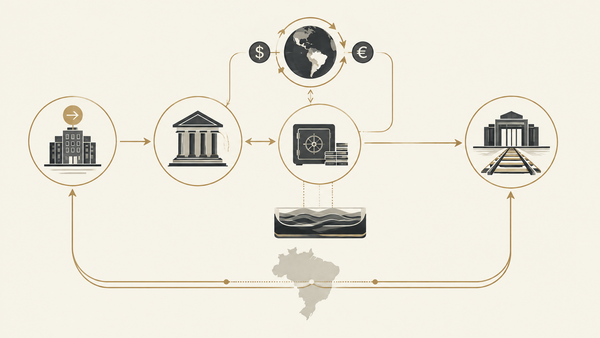
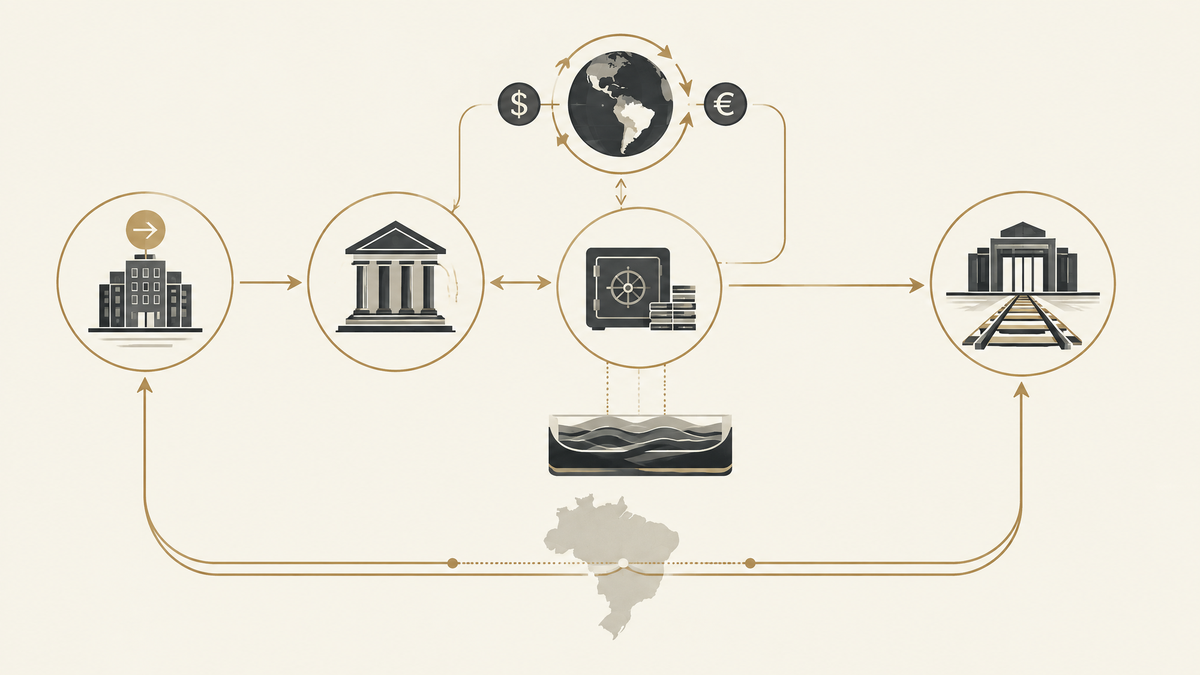
Every serious capital flow into or out of Brazil passes through the same five layers, in roughly the same order.
Capital injection. Banking. FX. Treasury and liquidity. Settlement.
Each layer has its own rules, its own timing, and its own failure modes. None of them can be skipped, and none of them can be fully outsourced to a single vendor who handles "Brazil" as one product.
Capital injection is a registration problem before it is a banking problem
Money entering Brazil as foreign investment has to be registered with the Central Bank before it does anything useful. That registration is what lets the capital, and eventually its returns, leave the country again through the regulated system.
This is not a formality to route around. It is the thing that makes the capital legible to the financial system at all. A dollar that arrives without proper registration is not cheaper. It is a dollar with no legal path home.
I have seen companies treat this step as paperwork to minimize. It is closer to the deed to the house. Skip it, or do it badly, and everything downstream inherits the defect.
Banking in Brazil is not one relationship, it is several
A CFO who thinks "we have a bank in Brazil" usually means one of three very different things: a correspondent relationship for wire transfers, a local operating account for domestic payments, or a full banking relationship with credit, custody, and reporting attached.
These are not interchangeable, and a route that works for domestic payroll will not necessarily work for repatriating capital.
Add to that a regulatory landscape that has spent the last few years pulling both traditional payment institutions and virtual asset service providers into a tighter, more explicit licensing structure. The direction of that change is consolidation, not retreat. Fewer, better capitalized, more accountable counterparties. That is worth knowing before choosing one, because today's counterparty is making an implicit bet on which side of that consolidation it ends up on.
FX is where most people start, and it should not be
I am not going to re-derive the execution, capital, time, operations, and risk breakdown here. Read the cost piece for that.
What I will say is this: the quoted rate is a snapshot of a market that is, itself, regulated, liquid, and structurally different from a spot market elsewhere. Brazil's FX market has real depth and real counterparties, but it also has documentation requirements tied directly to the capital registration step above. The rate and the registration are not two separate conversations. They are the same conversation, told from two different desks.
Treasury and liquidity are where the map gets personal
Once capital is in the country and converted, someone has to manage it day to day. That is treasury, and in Brazil it means holding a view on three things at once: how much BRL liquidity the business actually needs on hand, how much exposure to FX movement it is willing to carry until the next conversion, and how much of its own capital sits tied up as a buffer against settlement timing nobody fully controls.
None of this is exotic. It is the same treasury discipline that applies anywhere. What changes in Brazil is the settlement rail underneath it, which brings me to the part of the map most people outside Brazil have never actually seen work.
Pix changed what settlement means here
Pix is Brazil's instant payment system, run by the Central Bank. It settles through the Instant Payments System, a real time gross settlement system, and funds are available to the recipient in seconds, around the clock, every day of the year.
That is not a marketing description. It is the mechanism.
Scale gives a sense of what that mechanism actually carries. Pix processed 79.8 billion transactions in 2025, moving R$35.4 trillion. On a single day in September 2026, it settled over 318 million payments, moving nearly R$187 billion. This is not a niche rail. It is the primary way money moves inside Brazil now.
For a CFO, the practical consequence is this: the domestic leg of a Brazilian route is often the fastest, cheapest, most reliable part of the whole journey. The friction is almost never inside Brazil once money is BRL and inside the regulated system. The friction is at the edges, where capital crosses into or out of that system.
Stablecoins sit at exactly that edge
I covered this in more depth in "How stablecoins are transforming international FX," so I will not repeat the full argument. For this map, the relevant point is narrower: stablecoins do not replace any of the five layers above. They change how the FX and settlement layers connect to each other, sometimes compressing the time between a dollar leaving one jurisdiction and a BRL equivalent being usable inside Pix.
They do not remove the registration requirement. They do not remove counterparty risk. They introduce their own liquidity and price stability questions at the on and off ramp. Treat a stablecoin leg as one more component in the route, not as an exit from the system the rest of this map describes.
Reconciliation is the layer nobody budgets for
Every layer above produces a record: a registration number, a bank statement line, an FX contract, a Pix receipt. Reconciliation is the discipline of making sure those records agree with each other and with the company's own ledger.
It sounds administrative. It is where I have seen the most expensive surprises actually surface, because a mismatch discovered during an audit is a very different problem than the same mismatch caught the same week it happened.
Risk and time are not separate from any of this, they are inside all of it
I am deliberately not giving risk and time their own deep treatment here, because the cost piece already does that work in detail. What belongs on this map is simpler: every layer above carries a time cost and a risk profile, and a CFO who only evaluates one layer at a time will miss the combinations that actually cause problems. A registration delay compounds an FX timing problem. A banking relationship under regulatory stress compounds a treasury exposure you thought was hedged.
Why Brazil rewards this kind of mapping
Brazil combines a genuinely fast domestic settlement rail, a liquid and regulated FX market, an active and legally distinct stablecoin market, and real capital controls that touch every one of the layers above. Very few markets ask an operator to hold all of that in view at once. Treat any one layer as the whole picture and the route gets mispriced, even when every individual number quoted was accurate.
What this map does not tell you
It does not say which route is cheapest for a specific size and frequency. That is the cost piece's job, and it depends on facts specific to one company that I cannot generalize from here.
It also does not explain how to move capital around a rule that feels inconvenient. There is no version of this map that ends with evading registration, avoiding a licensed counterparty, or treating a stablecoin rail as a way to skip the regulated system. If a route only works by not being seen, it is not a route. It is a liability with a delay on it.
What would change my mind about the shape of this map is a genuine structural shift at one of the five layers, a change to how capital registration works, a material shift in who is allowed to hold a banking or VASP license, or a settlement rail that displaces Pix's role inside Brazil. None of those have happened yet. Until one does, this is the order I would teach a new CFO to think in, before they ever ask what the rate is today.
If you move meaningful volume through Brazil, the next read is the cost framework. This piece was the map. That one is the price.

Read in Portuguese: O mapa de um CFO para o Brasil: capital, câmbio, liquidez e liquidação
Follow the money through Brazil. Subscribe to ONCHAIN FX Weekly for the next note on markets, capital and the systems behind moving serious money.