How stablecoins are transforming international FX
The FX market moves $7.5 trillion a day. Stablecoins are capturing a growing share of that volume.

A version of this piece was first published on the author’s LinkedIn newsletter in November 2025 (see original publication).
Do you still think stablecoins are just another crypto-market product? Then you may have missed the moment they stopped being "digital assets" and became the invisible infrastructure of the global financial system.
In 2025, the stablecoin market surpassed US$300 billion in total value, per Yahoo Finance data. That's an impressive number — and, more importantly, a stable one, even through Bitcoin and Ethereum volatility. That shows the role of stablecoins is no longer speculative, but functional.
Nearly 99% of existing stablecoins are pegged to the US dollar. The absolute leaders — USDT (Tether) and USDC (Circle) — circulate on networks like Tron, Ethereum, and Solana, processing billions of dollars in transfers every day, together accounting for roughly US$280 billion of total circulating value. Tron dominates transactions in emerging markets on cost and speed; Ethereum functions as a pillar of reliability and compliance; Solana is emerging as a bridge for high-frequency corporate transactions.
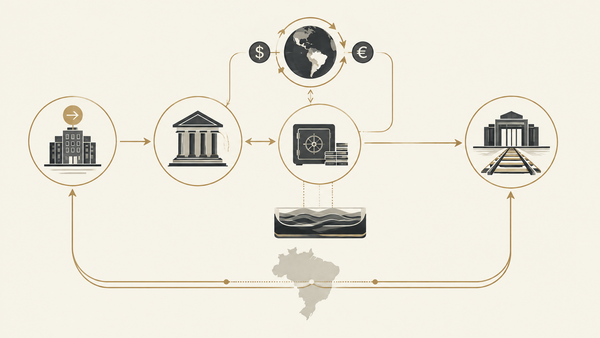
USD→Bank / stablecoin / venue
off-ramp layer→BRL→Pix
A cross-border dollar reaching a Brazilian account through a stablecoin rail, settling on Pix.
In Brazil, we've been watching this closely. At Coins.xyz, we work to make this infrastructure — which once felt distant from Brazilian reality — accessible and intuitive for anyone who needs to move value with predictability and security. What once looked like a "crypto-market innovation" is now consolidating into essential financial infrastructure: companies, funds, and even traditional financial institutions are using stablecoins as a practical alternative for payments, transaction settlement, and international transfers.
International FX is becoming obsolete
Why do we still accept paying 6%, waiting three days, and depending on banks to send money between countries? That's the question moving entire corporations toward stablecoins. Per the World Bank, the average cost of an international remittance runs around 6.3% of the amount sent, and can reach 10% on routes involving developing countries — with funds still passing through multiple intermediaries, each charging its own fee. A USDC transfer between two wallets on Ethereum can cost less than US$0.10 and settle in seconds, with a public, traceable, verifiable record.
And this is no longer marginal. Visa has been testing cross-border settlement with stablecoins, cutting operating costs and guaranteeing instant settlement. PayPal launched its own digital currency, PYUSD, used for international transfers on the Stellar network. Per the report Stablecoins and the Future of Cross-Border Payments (2025), monthly stablecoin transaction volume already exceeds US$1.5 trillion — more than the combined global operations of Western Union and MoneyGram. Tether's (USDT) daily volume already exceeds the average payment volume processed by PayPal.
In Latin America, growth is dizzying: stablecoin usage grew 400% over the past 12 months, led by Brazil, Argentina, and Mexico. In countries where currency volatility and inflation have eroded purchasing power, stablecoins have become more than an alternative — they've become a financial survival tool. Exporters are settling contracts in USDC or USDT to avoid FX losses; freelancers receive international payments in minutes, without 7–10% fees. At Coins.xyz, we've watched a community grow that uses stablecoins not as a technological novelty, but as a practical solution for receiving, paying, or simply preserving value with stability.
The economic impact: a new form of dollarization
Until recently, the only way to dollarize a country's economy was to hold reserves in foreign banks, issue dollar-denominated bonds, or create currency pegs. Now, it's enough for citizens and companies to use dollar-pegged stablecoins. A JPMorgan report warned that the rise of stablecoins could cause banks in emerging markets to lose up to US$1 trillion in deposits, as local money stops circulating domestically and is converted into digital dollars that escape local jurisdiction.
That reshapes the global monetary architecture: the dollar stops being just a currency and becomes a financial protocol, accessible via blockchain, without borders or bureaucracy. Major banks are already adapting — Standard Chartered is building stablecoin liquidity solutions for corporate clients, and JPMorgan Onyx created a private network for digital-asset settlement, an intermediate step between the traditional banking system and the new tokenized one.
Is the G20 falling behind?
In 2020, the G20 announced a plan to bring the global average remittance cost below 3% by 2027. Per Reuters, progress has been minimal. Meanwhile, stablecoins already deliver near-free transactions, instant settlement, and global access — while developed economies are still debating regulation, the market has already built its own solution. The European Union passed MiCA (Markets in Crypto-Assets), setting clear rules for stablecoin issuers; in the United States, the SEC and Treasury are still disputing who should oversee the sector, while Singapore and Hong Kong take the lead in corporate adoption.
The consequences for the global financial system
Are we heading toward a world without FX? In a scenario where digital dollars circulate freely, currency conversion becomes a niche operation, used only by those still dependent on legacy systems. If monetary power once sat with central banks, it is now migrating toward public and private blockchain-based networks — which doesn't mean the end of banks, but the start of a redefinition of their role: from intermediaries to custodians, liquidity providers, and regulatory gateways.
As this infrastructure consolidates, companies like Coins.xyz take on a natural role in the process: translating the system's complexity into solutions that are simple, stable, and aligned with local rules. For emerging markets, the challenge is twofold — avoiding the capital flight caused by digital dollarization while capturing the inclusion and efficiency stablecoins offer. A delicate but unavoidable balance.
Money is changing shape
What's underway isn't just a technological shift — it's a paradigm shift. The history of money has always been a history of trust: from metal and paper to numbers in banks, and now into the era of programmable tokens. Stablecoins are a link between past and future — the dollar's stability combined with the internet's fluidity. They make FX invisible, liquidity instant, and value truly global.
In the end, this may be the real transformation: money stops being a product of banks and becomes internet infrastructure — a protocol on top of which new financial services will be built. Little by little, the line between finance and technology disappears. This isn't the end of money as we know it, but the beginning of its most universal version.
Follow the money through Brazil.
ONCHAIN FX covers markets, capital, stablecoins, technology, infrastructure and the systems behind moving serious money. Get the next note in your inbox.
Moving meaningful volume through Brazil? Talk to us.